How It's Made
Seven steps between a flat hide and something you'll carry for twenty years. None of them are fast.
Pick the hide
I buy full-grain, vegetable-tanned leather, the outermost layer of the skin with the grain left on it. Nothing sanded down, nothing sprayed over. It's the strongest part of the hide and the only kind that develops a real patina instead of just wearing out.
Vegetable tanning takes weeks in pits of tree-bark tannins instead of hours in a chrome bath. It costs more and smells better, and it's why the leather darkens with sun and oil instead of staying the exact same colour until it cracks.
Read the hide before cutting it
No two hides are the same, and no two parts of one hide are the same. The back and butt are dense and firm, and that's where belts and straps come from. The belly is stretchy and goes to smaller parts or the scrap bin.
Brands, scars, insect bites and range marks all show up. I work around the ones that would weaken a panel and leave the ones that just tell you it was an animal.
Cut the pattern
Every pattern here is one I drafted, cut in scrap, carried around, and re-cut until it was right. Once it works, it becomes an acrylic or card template that gets traced and cut by hand with a round knife.
All the panels for a single piece come off the same hide, so the front, the back, and the flap all darken at the same rate. Mixed hides are why some bags end up three different colours after a year.
Mark and punch every hole
Stitch lines get scribed with a groover so the thread sits down in a channel and doesn't take the abrasion. Then the holes are punched with an iron and a maul, one strike at a time, at a consistent angle, which is what makes a hand-stitched seam look like a row of neat slashes rather than dots.
Saddle stitch it
Two needles, one thread, both needles through every hole from opposite sides. It's slow. A bag is a few hours of sitting there pulling thread, and it is the entire reason to buy handmade.
A sewing machine makes a lock stitch: one thread looping around another. Cut it anywhere and it unzips. A saddle stitch has two independent threads locked in each hole. Cut one and the other holds until you get it repaired.
Set the hardware
Solid brass, not plated pot metal. Buckles, swivel clips, rivets and posts get set into leather that's been reinforced where the load goes, because hardware doesn't usually fail. The leather around it does.
Burnish the edges
The part that takes the longest and shows the most. Edges get beveled to knock off the corners, sanded up through the grits, wetted, and then rubbed hard with a burnisher until the fibres lie down and the edge turns slick and dark.
The shortcut is edge paint, an acrylic coating that looks perfect for a year and then chips off in strips. A burnished edge is the leather itself, compressed. It just gets smoother.
Stamp it and send it
The Old Chief mark goes on last, struck into the leather. Then it gets a coat of conditioner, a final look over, and it goes in the mail to you.
From your order to your door is usually two to three weeks. If it's going to be longer, you'll hear it from me before you have to ask.
What you get to choose
Five leathers, four threads
These are the colours I keep on the shelf. If you want something outside them, just ask. I can usually source it.
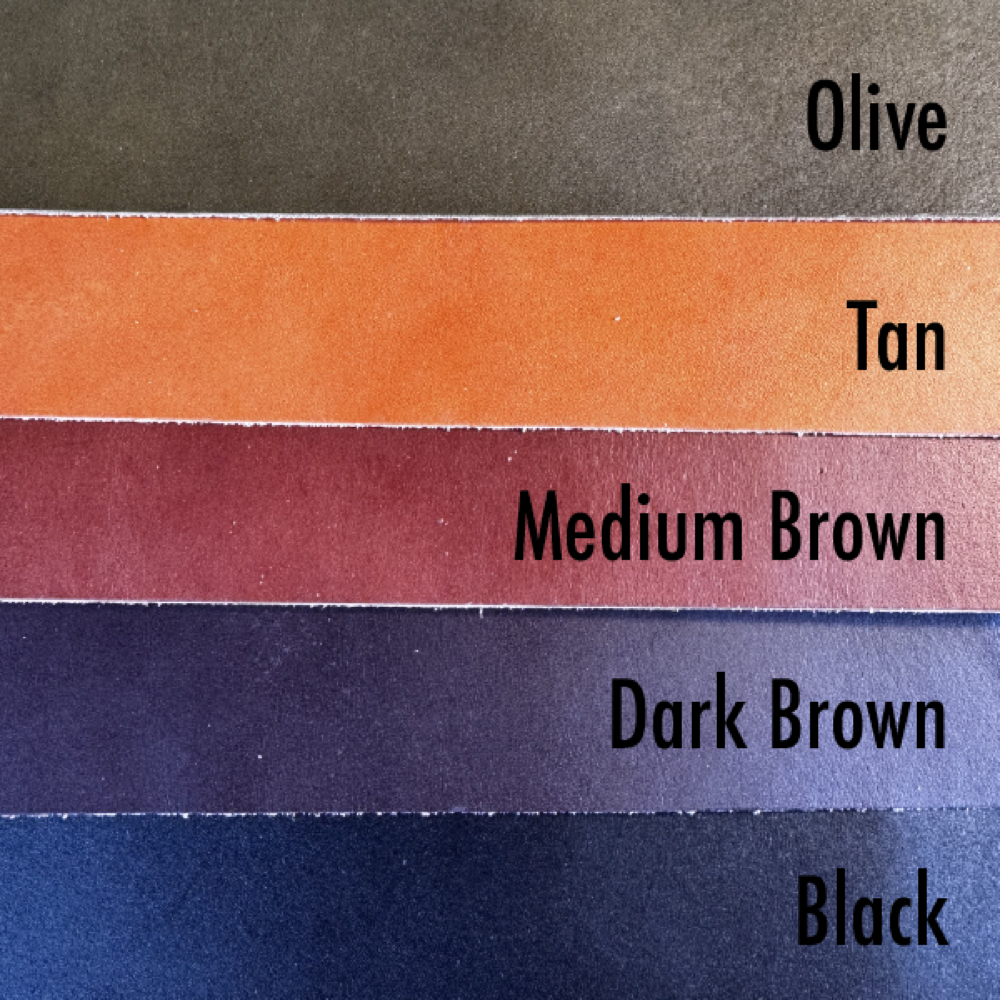
Leather: Olive, Tan, Medium Brown, Dark Brown, Black.
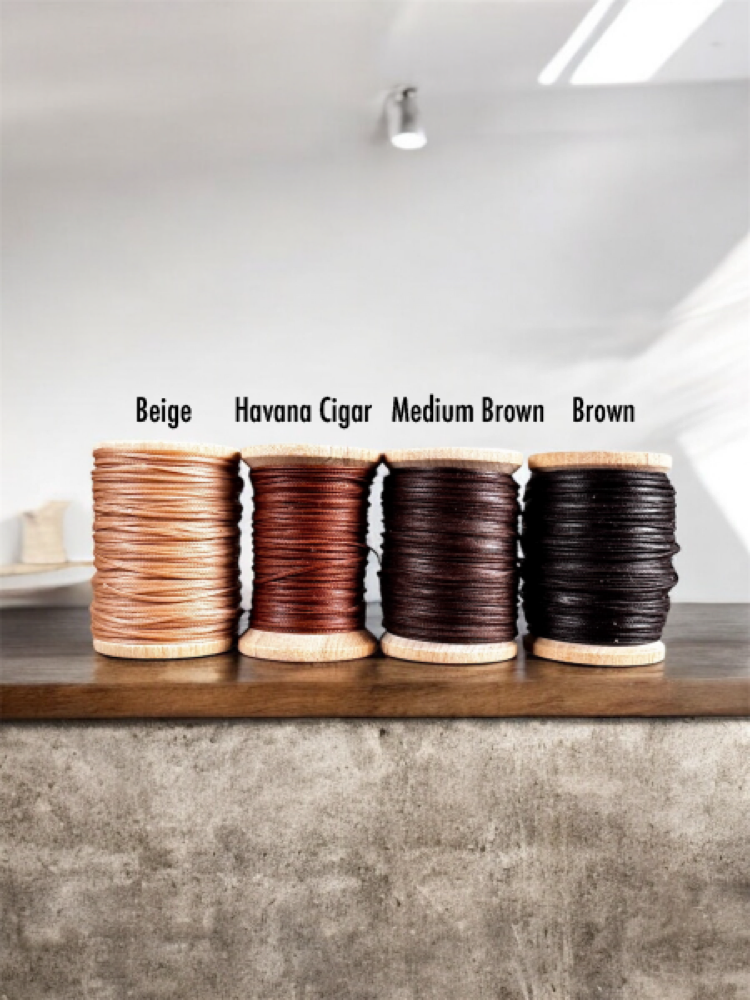
Thread: Beige, Havana Cigar, Medium Brown, Brown.
After it's yours
Taking care of it
Genuinely, the main thing is to use it. Leather that sits in a drawer dries out; leather that goes everywhere with you gets better.
Let it dry slowly at room temperature, away from radiators, heaters, and direct sun. Stuff a bag loosely with paper to hold its shape. Once it's dry to the touch, work in a light coat of conditioner. Drying is what pulls the oils out, and that's what you're putting back.
Once or twice a year for normal use. Less than you'd think. Over-conditioning makes leather limp and blotchy. A thin coat rubbed in with your hands beats a thick one every time.
That's the whole point. Vegetable-tanned leather darkens with sunlight and skin oils. A tan piece will be a rich brown within a year of daily carry, deepest where your hands touch it most. Nothing is going wrong.
Rub it with your thumb. Most fresh scratches in full-grain will burnish right back out with friction and body heat. The ones that don't become part of the record of where you've taken it.
Send it to me. Because it's saddle-stitched, one broken stitch doesn't unravel the seam, so there's no rush, but get it to me before the hole enlarges and I'll restitch that section. Failures of my own work are on me.